• O1 Network
    • Articles
    • For Residents
    • For Medical Students
    • PORT Notes
    • MSK Medicine
    • Tumor Library
    • Cases
    • Talks
    • Images
    • Viewpoints
    • Question Bank
    • Devices
    • Residency
    • Fellowships
    • Associations
    • Companies
ORTHOPAEDICSONE ARTICLES
OrthopaedicsOne Articles
  • Articles
    • Specialty
      • Arthroscopy
      • Foot and Ankle
      • Hand and Wrist
      • Hip and Knee
      • Infection
      • Joint Reconstruction
      • Musculoskeletal Medicine
      • Pediatrics
      • Shoulder and Elbow
      • Spine
      • Sports Medicine
      • Trauma
      • Tumor
    • Regional
      • Anatomy
      • Basic Science
      • Classifications
      • Diagnostic Tests
      • Evidence-Based Orthopaedics
      • Operative Techniques
      • Pain Management
      • Physical Examination
      • Pharmacology
      • Radiology
      • Rehabilitation
      • Rheumatology
      • Surgical Approaches
    • Professional
      • Bioethics
      • Economics and Health Policy
      • Epidemiology and Biostatistics
      • History of Orthopaedics
      • Informatics
      • Medicolegal
      • Mobile and Wireless
      • Practice Management
  • Reviews
    • For Residents
    • For Medical Students
  • eBooks
    • PORT Notes
    • MSK Medicine
    • Tumor Library
  • Community
    • Cases
    • Talks
    • Images
    • Viewpoints
    • Question Bank
    • Devices
  • Pages
    • Residency
    • Fellowships
    • Associations
    • Companies
  • About O1
    • Overview
    • FAQs
    • Managing Editors
    • Editorial Board
    • Content Partners
    • Participating Groups
    • Advisory Board
    • Sponsoring Organizations
    • Contact Us
  • Click to open the search input field Click to open the search input field Search
  • Menu Menu

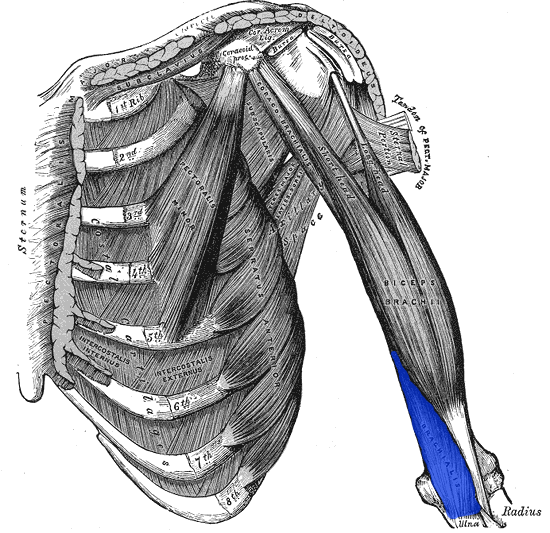
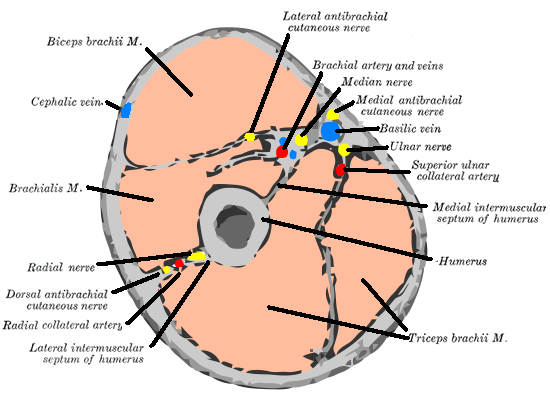
Brachialis

Origin

Anterior surface of the humerus, particularly the distal half of this bone

Insertion

Coronoid process and the tuberosity of the ulna

Action(s)

Flexion at elbow joint.

The brachialis is the strongest flexor of the elbow. Unlike the biceps, the brachialis does not insert on the radius, and therefore cannot participate in pronation/supination of the forearm.

Pronation/supination of the forearm does not affect its action.

Nerve Supply

Musculocutaneous nerve

Arterial Supply

Radial Recurrent Artery

Physical Exam

Enter physical examination maneuvers for muscle

Clinical Importance

Enter clinical importance of muscle

Disease States

Enter links to pages where muscle involved

Discussion

Occasionally doubled; additional slips to the supinator, pronator teres, biceps brachii, lacertus fibrosus, or radius are more rarely found.

Figures

Click thumbnail for larger image

Credits:

From Wikipedia:
Brachialis muscle

Attachments:


Brachialis.png (image/png)


brachialis1.png (image/png)

Last Updated on June 27, 2024

🔗 Knowledge Graph & Clinical Correlates

OrthopaedicsOne Living Semantic Network

🩺 Clinical Conditions & Indications

  • Treatment Options for Distal Humeral Fractures Fractures of the distal humerus are less common than other fractures frequently encountered by orthopaedic surgeons, yet when...

🔬 Anatomy, Pathology & Diagnostics

  • Wrist joint Wrist and Carpus
  • Vertebra prominens Surface Anatomy Lumbar Spine
  • Vastus medialis Femoral Shaft
  • Vastus lateralis Femoral Shaft

🕸️ Semantic Relations (RDF)

ABOUT

  • Overview
  • FAQs
  • Managing Editors
  • Editorial Board
  • Content Partners
  • Participating Groups
  • Advisory Board
  • Sponsoring Organizations
  • Contact Us

ARTICLES

  • Arthroscopy
  • Foot and Ankle
  • Hand and Wrist
  • Hip and Knee
  • Infection
  • Joint Reconstruction
  • Musculoskeletal Medicine
  • Pediatrics
  • Shoulder and Elbow
  • Spine
  • Sports Medicine
  • Trauma
  • Tumor

REVIEWS

  • For Residents
  • For Medical Students

EBOOKS

  • PORT Notes
  • MSK Medicine
  • Tumor Library

COMMUNITY

  • Talks
  • Images
  • Viewpoints
  • Question Bank
  • Devices

PAGES

  • Residency
  • Fellowships
  • Associations
  • Companies
Copyright © 2012-2026 OrthopaedicsOne | Privacy Policy | Dr. Christian Veillette . Powered by: OrthoNet - Empowering the Future of Orthopaedic Care
Scroll to top Scroll to top Scroll to top