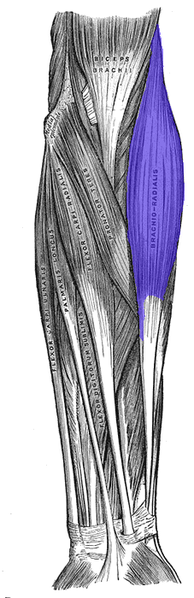
Origin | Lateral supracondylar ridge of the humerus |
|---|
Insertion | Distal radius (Radial styloid process) |
|---|
Action(s) | Brachioradialis flexes the forearm at the elbow. When the forearm is pronated, the brachioradialis tends to supinate as it flexes. In a supinated position, it tends to pronate as it flexes. The brachioradialis is a stronger elbow flexor when the forearm is in a midposition between supination and pronation at the radioulnar joint. When pronated, the brachioradialis is more active during elbow flexion since the biceps brachii is in a mechanical disadvantage. |
|---|
Nerve Supply | Despite the bulk of the muscle body being visible from the anterior aspect of the forearm, the brachioradialis is a posterior compartment muscle and consequently is innervated by the radial nerve. Of the muscles that receive innervation from the radial nerve, it is one of only four that receive input directly from the radial nerve. The other three are the triceps, anconeus, and extensor carpi radialis longus. (All other posterior compartment muscles that receive radial innervation are supplied by the deep branch of the radial nerve.) |
|---|
Arterial Supply | Radial recurrent artery |
|---|
Physical Exam | Enter physical examination maneuvers for muscle |
|---|
Clinical Importance | Enter clinical importance of muscle |
|---|
Disease States | Enter links to pages where muscle involved |
|---|
Discussion | Discussion on muscle |
|---|
| Figures |
Attachments:
Last Updated on June 27, 2024
🔬 Anatomy, Pathology & Diagnostics
🕸️ Semantic Relations (RDF)