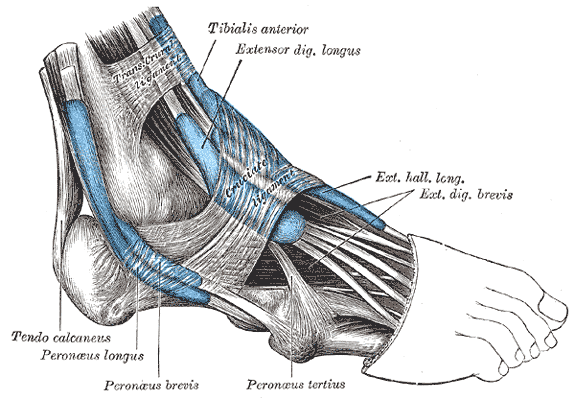
Origin | Lateral Condyle of tibia and superior ¾ of interosseous membrane |
|---|
Insertion | Middle and Distal phalanges of lateral four digits |
|---|
Action(s) | Extension of toes and ankle |
|---|
Nerve Supply | Peroneal nerve |
|---|
Arterial Supply | Anterior tibial artery |
|---|
Physical Exam | Enter physical examination maneuvers for muscle |
|---|
Clinical Importance | Enter clinical importance of muscle |
|---|
Disease States | Enter links to pages where muscle involved |
|---|
Discussion | This muscle varies considerably in the modes of origin and the arrangement of its various tendons. The tendons to the second and fifth toes may be found doubled, or extra slips are given off from one or more tendons to their corresponding metatarsal bones, or to the short extensor, or to one of the interosseous muscles. A slip to the great toe from the innermost tendon has been found. |
|---|
| Figures |
Attachments:
Last Updated on June 27, 2024
🧭 Surgical Approaches & Danger Zones
🩺 Clinical Conditions & Indications
- Ulnar shaft fractures Introduction Summary about significance of fracture including epidemiology. Anatomy Review the relevant anatomy of the bone, the joint,...
- Ulnar fractures Introduction Summary about significance of fracture including epidemiology. Anatomy Review the relevant anatomy of the bone, the joint,...
- Ulnar deficiencies 1. High-Yield Summary Core Pathoanatomy: Congenital ulnar longitudinal deficiency (ulnar dysplasia or ulnar club hand) is a rare...
- Ulna shaft fracture Introduction Forearm fractures more commonly occur in men than women, owing to a higher incidence in men of...
🔬 Anatomy, Pathology & Diagnostics
🕸️ Semantic Relations (RDF)