
Classification
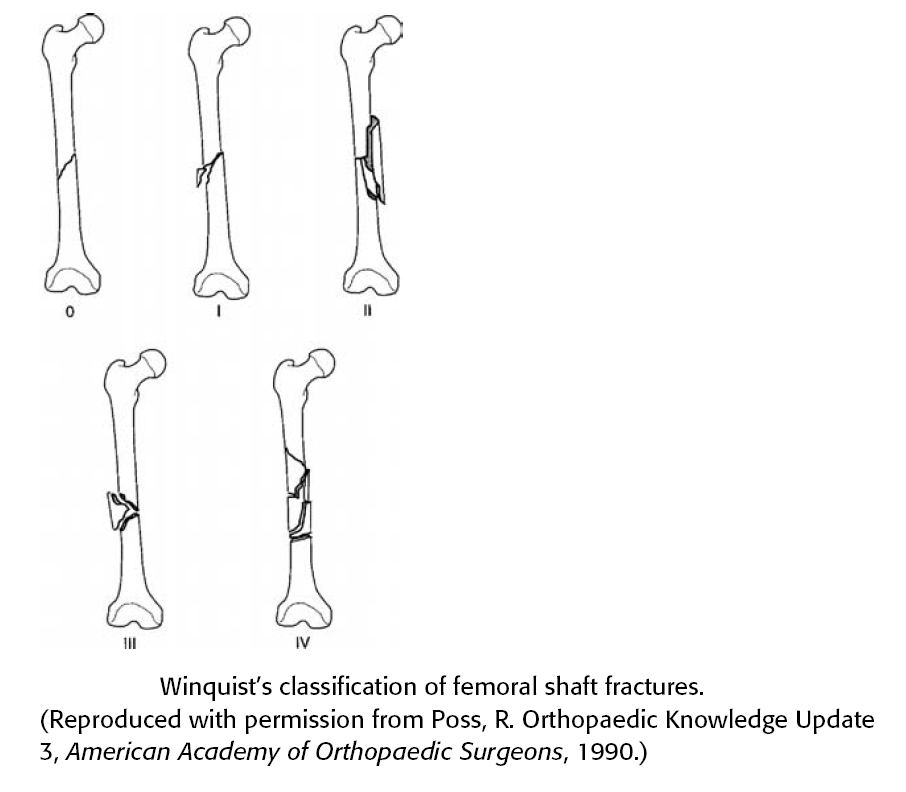
Type I
Minimal or no comminution; if comminution is present, there is involvement of 25% or less of the bony circumference
Type II
Comminuted fragments involve up to 50% of the width of the bone
Type III
Comminuted fragment involves more than 50% of the width of the bone; leaves only a small area of contact between the proximal and distal fragments
Type IV
Comminution involves the entire bony circumference; no cortical contact
Explanation
Femoral shaft fractures are often described in terms of the level at which they occur (proximal, middle, distal third) and configuration (spiral, transverse, oblique, segmental, comminuted). In 1980, Winquist proposed a classification based on fracture comminution.
Figures

Reference(s)
Provide the citation for the landmark article and recent review articles describing the classification
Attachments:

Last Updated on June 27, 2024
🔗 Knowledge Graph & Clinical Correlates
OrthopaedicsOne Living Semantic Network🛠️ Operative Techniques
🧭 Surgical Approaches & Danger Zones
- Universal approach to distal femur Femoral Shaft
🩺 Clinical Conditions & Indications
- Wrist fractures Introduction Summary about significance of fracture including epidemiology. Anatomy Review the relevant anatomy of the bone, the joint,...
- Visceral blunt trauma 1. High-Yield Summary Visceral blunt trauma encompasses severe mechanical disruption to abdominal and pelvic solid and hollow organs...
- Varus instability 1. High-Yield Summary Primary Pathomechanic Restraint: In the knee, the fibular (lateral) collateral ligament (FCL) serves as the...
- Ulnar shaft fractures Introduction Summary about significance of fracture including epidemiology. Anatomy Review the relevant anatomy of the bone, the joint,...
🔬 Anatomy, Pathology & Diagnostics
- What Rate of Utilization Is Appropriate in Musculoskeletal Care General Musculoskeletal
- Vastus medialis Femoral Shaft
- Vastus lateralis Femoral Shaft
- Vastus intermedius Femoral Shaft