
Contents
- Name of bone
- Location/Articulation
- Muscle and ligament attachments
- Surface anatomy
- Radiography
- Physical examination
- Embryology
- Anomalies
- Injuries/Disorders
- Figures
Name of bone
Thoracic vertebrae
Location/Articulation
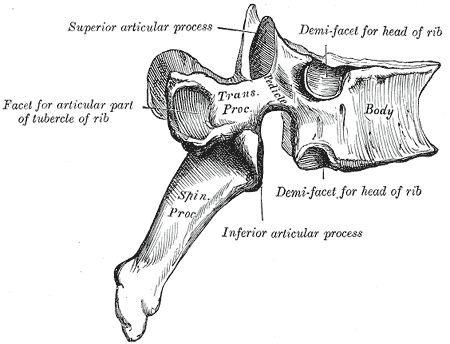
The 12 thoracic vertebrae compose the middle segment of the vertebral column, between the cervical vertebrae and the lumbar vertebrae. They are intermediate in size between those of the cervical and lumbar regions; they increase in size as one proceeds down the spine, the upper vertebrae being much smaller than those in the lower part of the region. They are distinguished by the presence of facets on the sides of the bodies for articulation with the heads of the ribs, and facets on the transverse processes of all, except the eleventh and twelfth, for articulation with the tubercles of the ribs.
Muscle and ligament attachments
Enter important muscle and ligament attachments
Surface anatomy
First thoracic vertebra
- The first thoracic vertebra has, on either side of the body, an entire articular facet for the head of the first rib, and a demi-facet for the upper half of the head of the second rib.
- The body is like that of a cervical vertebra, being broad transversely; its upper surface is concave, and lipped on either side.
- The superior articular surfaces are directed upward and backward; the spinous process is thick, long, and almost horizontal.
- The transverse processes are long, and the upper vertebral notches are deeper than those of the other thoracic vertebrae.
- The thoracic spinal nerve 1 (T1) passes out underneath it.
Second thoracic vertebra
- The thoracic spinal nerve 2 (T2) passes out underneath it.
Third thoracic vertebra
- The thoracic spinal nerve 3 out underneath it.
Fourth thoracic vertebra
- The fourth thoracic vertebra, together with the fifth, is at the same level as the sternal angle.
- The thoracic spinal nerve 4 (T4) passes out underneath it.
Fifth thoracic vertebra
- The fifth thoracic vertebra, together with the fourth, is at the same level as the sternal angle.
- The thoracic spinal nerve 5 (T5) passes out underneath it.
Sixth thoracic vertebra
- The thoracic spinal nerve 6 (T6) passes out underneath it.
Seventh thoracic vertebra
- The thoracic spinal nerve 7 (T7) passes out underneath it.
Eighth thoracic vertebra
- The eighth thoracis vertebra is, together with the ninth thoracis vertebra, at the same level as the xiphoid process.
- The thoracic spinal nerve 8 (T8) passes out underneath it.
Ninth thoracic vertebra
- The ninth thoracic vertebra may have no demi-facets below. In some subjects however, it has two demi-facets on either side; when this occurs the tenth doesn’t have facets but demi-facets at the upper part.
- The thoracic spinal nerve 9 (T9) passes out underneath it.
Tenth thoracic vertebra
- The tenth thoracic vertebra has (except in the cases just mentioned) an entire articular facet (not demi-facet) on either side, which is placed partly on the lateral surface of the pedicle. It doesn’t have any kind of facet below, because the following ribs only have one facet on their heads.
- The thoracic spinal nerve 10 (T10) passes out underneath it.
Eleventh thoracic vertebra
- In the eleventh thoracic vertebrae the body approaches in its form and size to that of the lumbar vertebrae.
- The articular facets for the heads of the ribs are of large size, and placed chiefly on the pedicles, which are thicker and stronger in this and the next vertebrae than in any other part of the thoracic region.
- The spinous process is short, and nearly horizontal in direction.
- The transverse processes are very short, tuberculated at their extremities, and have no articular facets.
- The thoracic spinal nerve 11 (T11) passes out underneath it.
Twelfth thoracic vertebra
- The twelfth thoracic vertebra has the same general characteristics as the eleventh, but may be distinguished from it by its inferior articular surfaces being convex and directed lateralward, like those of the lumbar vertebrae; by the general form of the body, laminae, and spinous process, in which it resembles the lumbar vertebrae; and by each transverse process being subdivided into three elevations, the superior, inferior, and lateral tubercles: the superior and inferior correspond to the mammillary and accessory processes of the lumbar vertebrae. Traces of similar elevations are found on the transverse processes of the tenth and eleventh thoracic vertebrae.
- The thoracic spinal nerve 12 (T12) passes out underneath it.
Radiography
Enter radiographic images and landmarks
Physical examination
Enter relevant physical exam maneuvers for this bone
Embryology
Enter embryology for this bone
Anomalies
Enter anomalies for this bone
Injuries/Disorders
Enter links to pages for injuries or disorders where this bone is involved
Figures

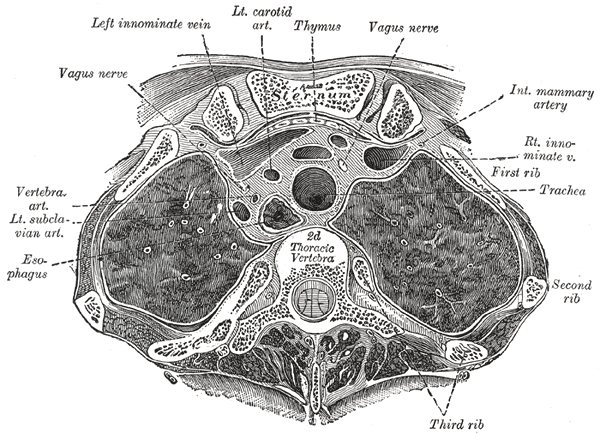
Figures 1 and 2. Two views of a thoracic vertebra
Attachments:

Last Updated on September 27, 2026
🔗 Knowledge Graph & Clinical Correlates
OrthopaedicsOne Living Semantic Network🔬 Anatomy, Pathology & Diagnostics
- Wrist joint Wrist and Carpus
- Vertebra prominens Surface Anatomy Lumbar Spine
- Vastus medialis Femoral Shaft
- Vastus lateralis Femoral Shaft